
Are conservatives more post-literate than liberals?, America 100 years ago, hurrah for economic growth and a lock of Dr Johnson's hair
Plus more links and quotes

Hello!
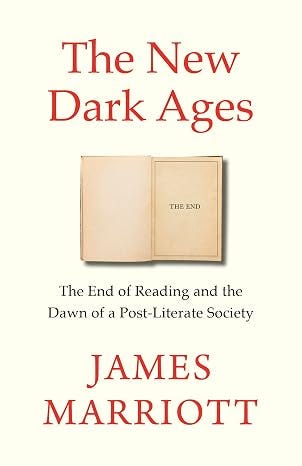
Welcome to Cultural Capital. My forthcoming book about the decline of reading, The New Dark Ages goes to the printers this week! It’s out on the 3rd of September.
I am rather exhaustingly over familiar with my own psychology so I should have expected this but I am finding the experience of letting go of the book impossible. I can’t stop trying to tweak it and am having to almost physically restrain myself from emailing my publisher with suggestions for extraneous adverbs that should be deleted.
Frankly, I am at the point of wondering whether it would be possible to break into the printing factory and try to add extra hand-written explanatory footnotes and crossings-out to every copy as they slide through the printers.
I hope all this stress is worth it. I keep trying to remind myself of Dr Johnson’s dictum that, “What is written without effort is in general read without pleasure”. According to this theory it should be incredibly pleasurable to read.
America 100 years ago
I enjoyed this by the inimitable Derek Thompson, looking at social trends in America 100 years ago in 1926. Everything changes and everything stays the same:
In some ways, the Americas of 2026 and 1926 are eerily similar. In both cases, the country is celebrating a major birthday in the midst of a rising stock market and widespread fears of “technological unemployment” (mechanical power then vs. AI now); giddy wealth is coiled with economic anxiety; technology has transformed the way that people get information, mind-wiring us to a global cacophony of far-flung emotions (radio then vs. social media now); and after years of record-high immigrant entry to the U.S., the government has choked the migrant stream to a trickle.
In other ways, the America of 1926 was another world—practically another planet. Roughly half of the U.S. still counted as rural, and tens of millions of Americans had no indoor plumbing or electricity. Thick smoke from oil lamps filled their homes, and they emptied their bladders and bowels in old-fashioned chamber pots. Women had only voted in two presidential elections. Millions of children still worked for pay. Of the nation’s 27 million households, only 11 million had a phonograph, to listen to music, or a car. The first movie with sound would not come out for another year.
Though it’s hard not to be envious of the fact that they were living through the opposite of our literacy crisis:
Authors were celebrities—people mobbed Sinclair Lewis’s Minnesota home while he was trying to write his novels—and books published annually had doubled since the 1910s. For those overwhelmed by so many titles, the Book-of-the-Month Club was founded in 1926. Magazine advertising revenues grew by 500 percent in the Twenties, thanks to the birth of Reader’s Digest in 1922, Time in 1923, and The New Yorker in 1925. Newspaper sales also rose throughout the decade, and New York City alone had twelve daily papers.
Nowadays if you’re an author and people are mobbing your house it’s not usually a good sign.
Music listening by political party
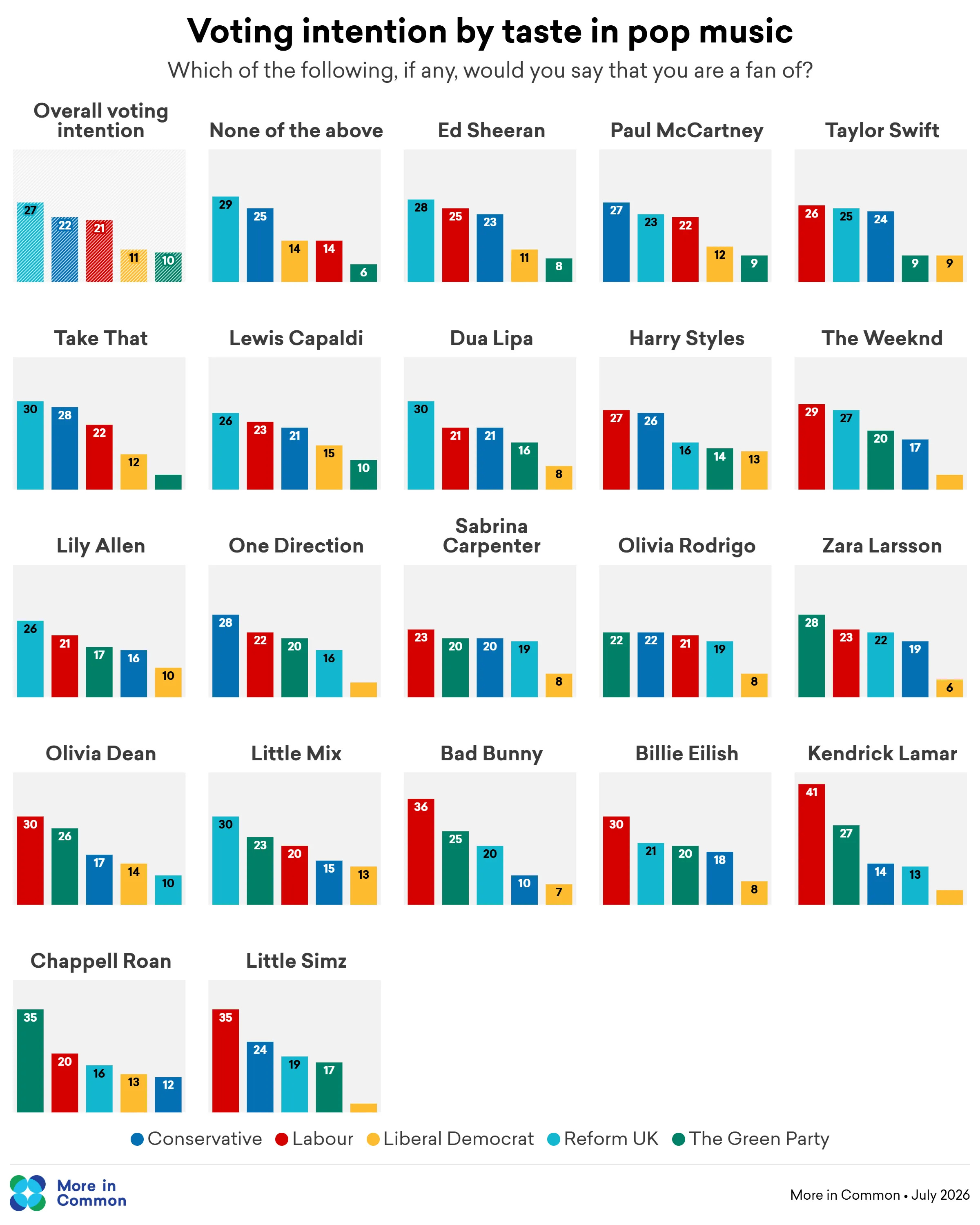
I have no idea what on earth to make of this mad survey from Luke Tryl of More in Common tracking the popularity of various musicians among supporters of different political parties. Paul McCartney being popular among Conservative voters is presumably an age effect. But why is Lily Allen so popular among Reform voters??
Why we need economic growth
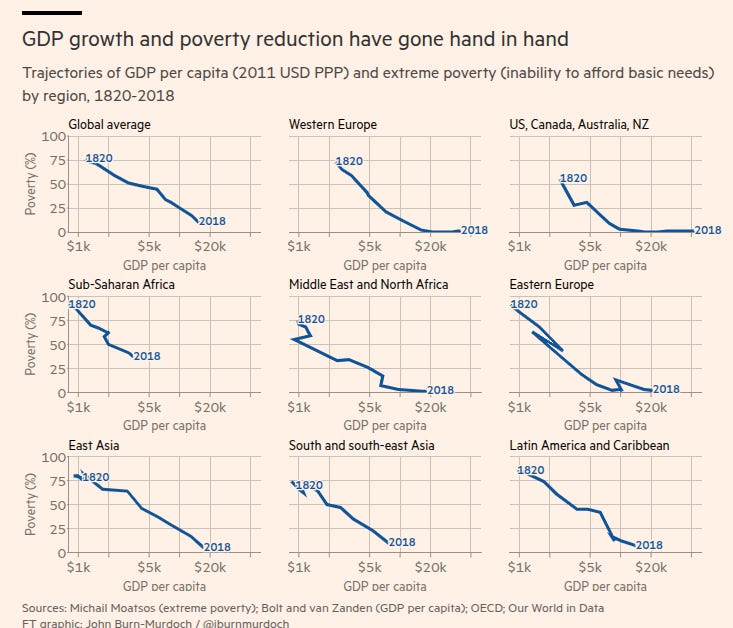
John Burn Murdoch is interesting as always on the benefits of economic growth. Contrary to the popular myth that wealth can’t make you happy it seems that economic growth does make populations happier, even in rich nations:
… earlier this year new research pushed back on the argument that once a country becomes rich enough, further economic growth doesn’t boost wellbeing. After adjusting for the way people change their frame of reference over time, focusing instead on whether they say they are doing better than in the past, the research found life satisfaction continued to climb alongside GDP per capita even in countries as rich as the US. Moving away from individual material wellbeing to broader societal measures, research finds that economic growth fosters trust in government and prosperity boosts social cohesion. Indeed, the past decade of political turmoil in Britain has coincided not with rising inequality (it has been falling) but with anaemic growth.
The mystery of our depopulating planet
Last week I recommended Ed Conway’s excellent new economics podcast. There’s another good episode this week on the mystery of declining birth rates. He explores the idea that complicated rules about children’s car seats are limiting family size and speaks to Alice Evans (of whom I’m a big fan) who makes the compelling case that smartphones are an important part of the story.
Are conservatives more post-literate than liberals?
Re-reading The New Dark Ages it struck me that the book is much harder on Republicans than on Democrats. This slightly annoyed me as it isn’t supposed to be a partisan attack. But it is unavoidably true that a lot of the most extravagantly medieval-seeming post-literate characters — the ones being attacked by demons and prophesying the return of the anti-Christ — come from the American right.
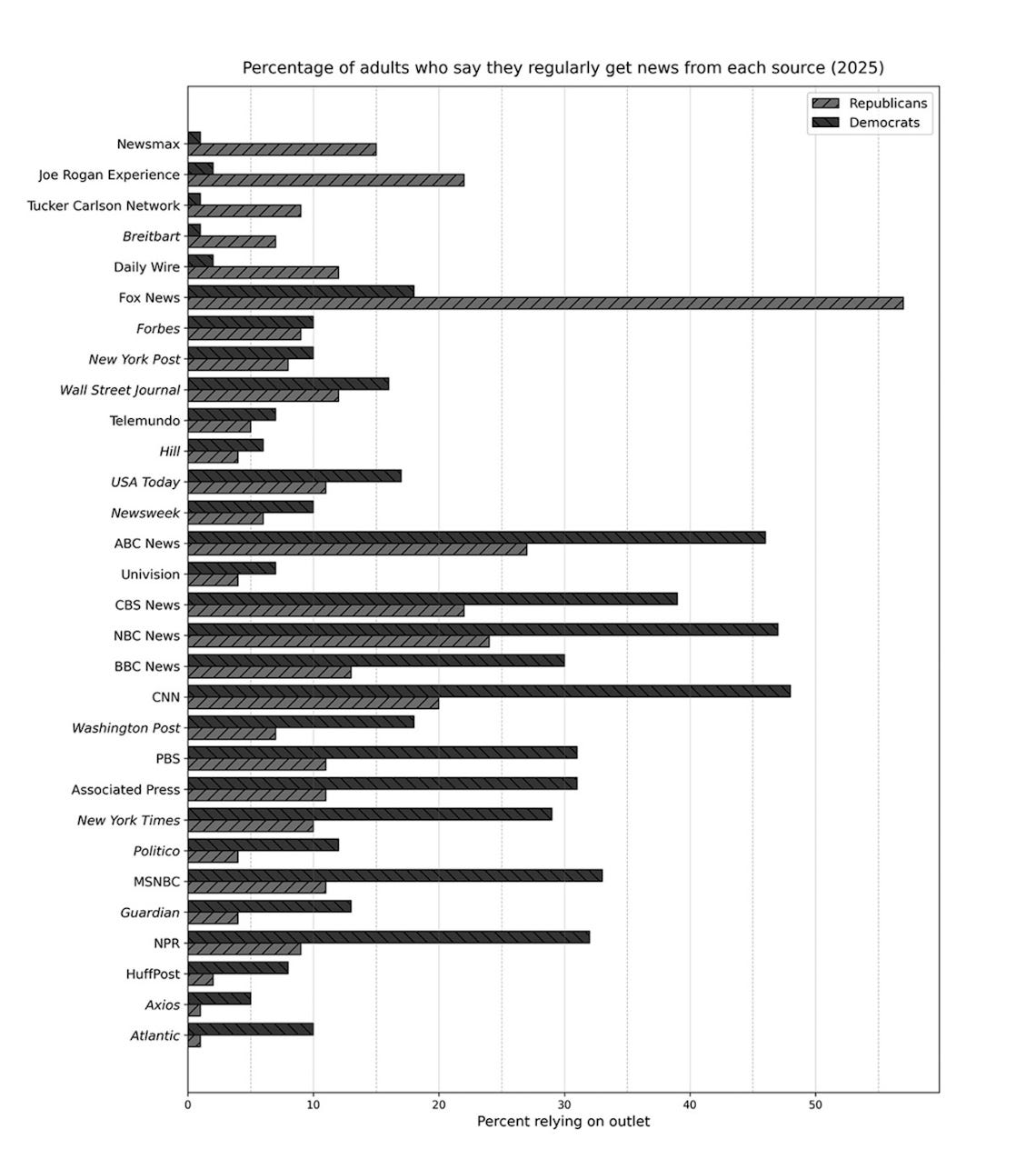
As this graph shared by Richard Hanania shows, the right does seem to be more post-literate than the liberal left. Democrats are much more likely to get their information from newspapers than Republicans. Podcasters and television are more influential on the right.
I suppose it’s an inevitable result of the fact that education level not class is now the great divide in politics. Statistically liberals are more educated than conservatives and are therefore much more plugged into a literate culture. Though nobody who has read much about what is going on with university students can feel confident that things will stay this way for long.
Dr Johnson
I’ve been signed up to do a lot of literary festivals to promote The New Dark Ages — I suppose a consequence of the fact my book addresses a zeitgeisty “talking point”. I have even been sent a spreadsheet instructing me where to go and when. So I will be travelling all across the country spreading my message of doom like a medieval flagellant.
This week as a kind of prequel to the big tour I was at Dr Johnson’s House talking to Henry Oliver of Common Reader fame. Dr Johnson appears as a kind of recurring character/mascot in The New Dark Ages. So it felt appropriate (and slightly mind-boggling) to speak in the room that Johnson wrote his famous dictionary.
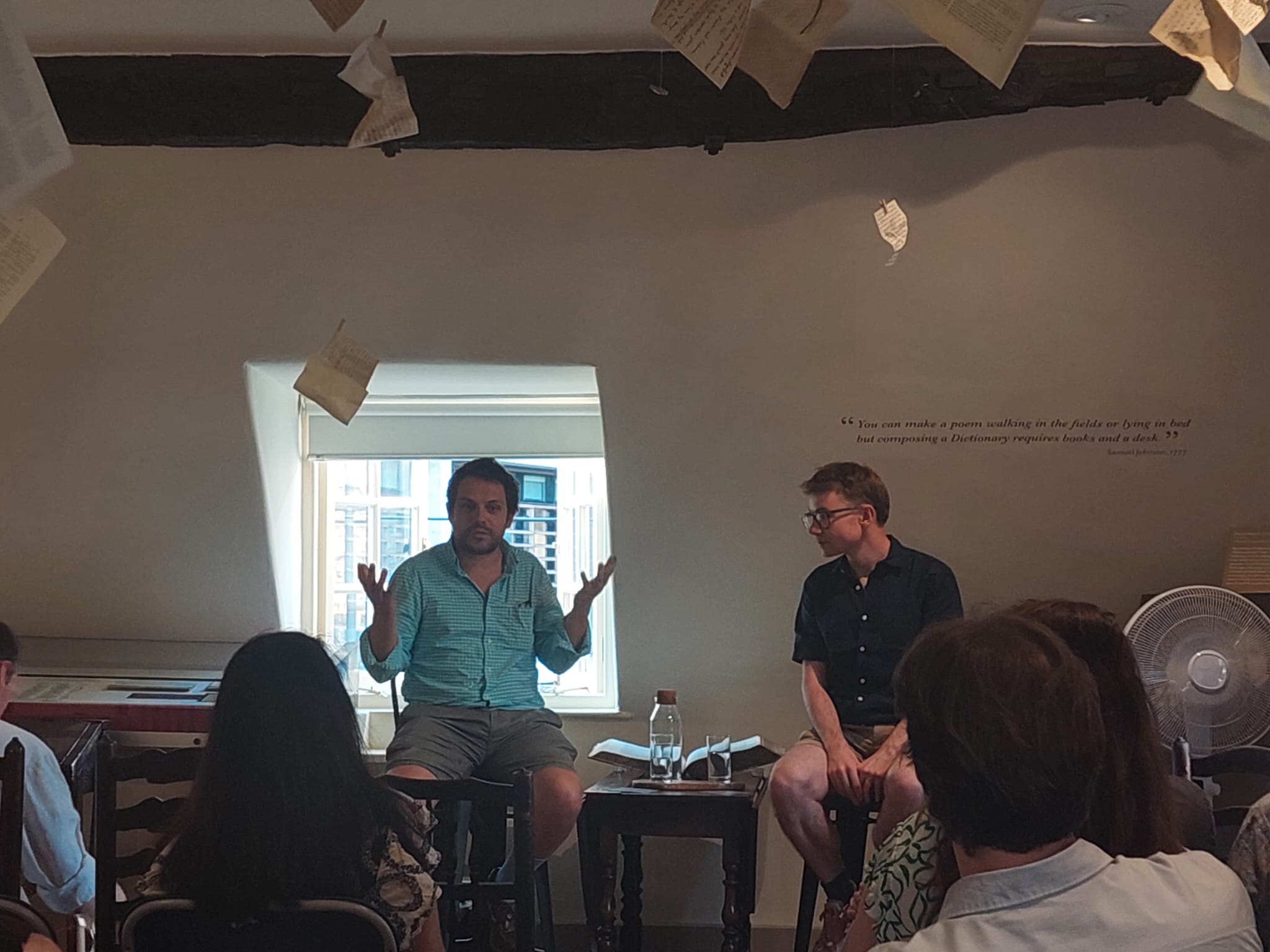
The museum is great. We got to see Dr Johnson’s letters, Dr Johnson’s books (with his notes in them) and even a lock of Dr Johnson’s hair. Exciting stuff (if you’re into Dr Johnson).
Until next week,
James
And as the Good Dr Johnson says, “what is read twice is commonly better remembered than what is transcribed.” Double readings of The New Dark Ages, folks.
My hunch is that Lilly Allen x Reform is, as ever in Britain, a class thing. I think the slightly avant garde approach to her new material and touring weakens the link slightly, but my rough guess is that (if only in accent and early mannerisms) she's quite Kent/Essex-coded. I also think her early stuff in mid 00s was at that peak of 'chav' era, and it had a genuinely working class appeal. It was unpretentious, 'real' etc etc. So very loose theory would be those southern teenagers/twentysomethings that loved her then are now in their 40s and love Nigel Farage equally...?