

Hello,
On the AI theme I’m amazed at how good Chat-GPT has got. It’s a much better creative writer than it was a year or so ago: it uses metaphors, figurative language and unexpected juxtapositions of words. It’s even capable of being funny.
It’s extraordinary (and alarming) to think how good it will be in five/ten/twenty years time.
I’ve spent the last week testing my friends, family and colleagues to see whether they can distinguish AI from human poetry. Most did well. But it’s not as easy as you’d hope.
Can you tell the real Seamus Heaney from the AI version?
Thresh
A crackle, then the slow flare
of flax-rope kindling peat,
a hearth-deep, winter-starting
blue-grey breath of smoke—
I walked the lane to Carrick
where they turned the sod
for a culvert’s black mouth,
the drowned fen bleeding moss.
Past the stones of Dungiven
and the unroofed chapel,
the rain-slick altar
where Mass was said in whispers.
What hoard lies buried there?
A bone comb, a spindle-whorl,
or only the silence of marl,
the hush before the ploughshare.
At dusk, beside a dry dyke,
I tasted rust in the mist
and heard my grandfather cough
through the nettles and blackthorn—
a rasp, a clod falling,
the wind-lift of chaff,
and the lonesome clink
of a spade left leaning.
VS
Leavings
A soft whoosh, the sunset blaze
of straw on blackened stubble,
a thatch-deep, freshening
barbarous crimson burn –
I rode down England
as they fired the crop
that was the leavings of a crop,
the smashed tow-coloured barley,
down from Ely’s Lady Chapel,
the sweet tenor Latin
forever banished,
the sumptuous windows
threshed clear by Thomas Cromwell.
Which circle does he tread,
scalding on cobbles,
each one a broken statue’s head?
After midnight, after summer,
to walk in a sparking field,
to smell dew and ashes
and start Will Brangwen’s ghost
from the hot soot –
a breaking sheaf of light,
abroad in the hiss
and clash of stooking.
Answer at the bottom of the email.
Other things
Or maybe it’s all fine
The Economist on why AI hasn’t taken your job (yet). Far from declining “the share of employment in white-collar work has risen very slightly” over the last year.
There are two competing explanations for this trend. The first is that, despite the endless announcements about how firms are ushering AI into their operations, few make much use of the technology for serious work. An official measure suggests that less than 10% of American companies employ it to produce goods and services. The second is that even when companies do adopt the tech, they do not let people go. AI may simply help workers do their jobs faster, rather than making them redundant.
Catholic revival in France
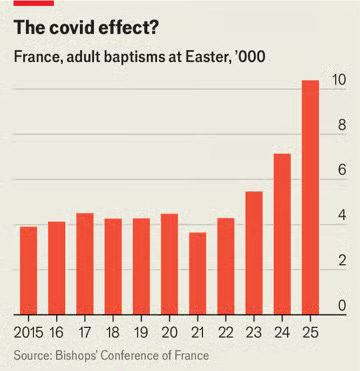
The numbers of adult baptisms in France have skyrocketed in the last couple of years. A fascinating social trend. My suspicion is that at least part of it is an identitarian “Western civilisation” thing in the context of immigration from Muslim countries. It seems that every other right wing influencer on Twitter has suddenly converted to Christianity over the last couple of years.
Against television
I love tirades against television written by twentieth century intellectuals. This by Robert Hughes may be the best I’ve read. Preposterously snobbish in some ways but also (I can’t help feeling) rather prescient:
When I try to describe my childhood to my godchildren, they look at me with pity. They find a world without television as unimaginable as one in which you had to draw water from the well in a bucket, instead of turning the faucet in the house. And yet, on another level, their imaginative input—and that of millions upon millions of other children, particularly in America—seems rather primitive to me, given the tribalism of television and its ability to enforce whatever is most passive in collective dreaming. Television inducts children very early into the ethos of total global marketing, creating fantasy figures (the latest being the Mighty Morphin Power Rangers, their antecedents the Teenage Mutant Ninja Turtles) which then become toys, which in turn have countless spin-offs. The amusements of my childhood weren’t quite so passive, from reading to making small balsa planes that didn’t fly very well to learning to fish, hunt, watch birds, and perform sickening experiments on beetles and spiders, thus preparing for my later life as a critic.
The politics of the post-literate society
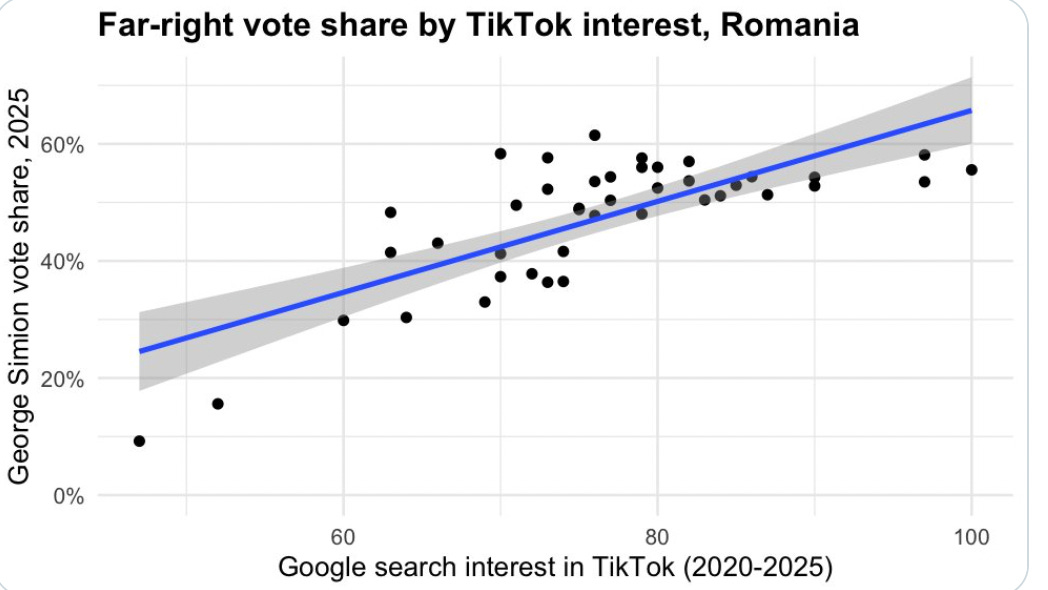
Sam Freedman on how using TikTok and not reading books correlates with support for right wing populist parties. Probably because people who read more have the high levels of education and income which tend to predict support for left and establishment parties. But also presumably because populists rely more on emotive and less on intellectual appeals to voters.
Polling has also found that those who read “a great deal” or “a lot” of political news were more likely to vote for Harris than Trump, but that those who read none at all went for Trump 51% to 32%.
This group is more likely to get news from social media, and increasingly from highly visual sites like TikTok. Pollster David Shor recently noted that the swing away from Harris was greatest amongst those who got their news from TikTok. The same is true for Reform voters.
Ian Leslie made the same point in his newsletter last weekend. He argued that “TikTok is rocket fuel for populists” and included this interesting graph mapping interest in TikTok against support for Romania’s right-wing populist leader George Simion:
The world’s most unreadable novelist?
I love Michael Hofmann (famous as the translator of Joseph Roth into English). He has a very funny new piece in the New York Review of Books about trying to read the apparently unreadable Russian novelist Andrey Platonov:
There probably is a way to read the Soviet novelist Andrey Platonov and come away from the experience with something, but I didn’t find it. I read four of his bright dark works in English (it took me ten months), and I have next to nothing to say about them. They might as well have been written in some other alphabet for all the good I got out of them. (They were.—Ed.) My progress was painfully slow; two pages a day was about my limit. Even that was enough to exhaust me, and to color the days. There went 2024. Platonov wrote his books faster than I could read them. Still, some fossilized sense of duty, presumed long extinct, kept me going. I blamed my circumstances. It was the chair. It was my reading glasses. It was the light. Actually, it was the books.
How to look rich
Advice for looking rich by cheaply printing and framing open-access images from the internet.

The decline of rhyme over time
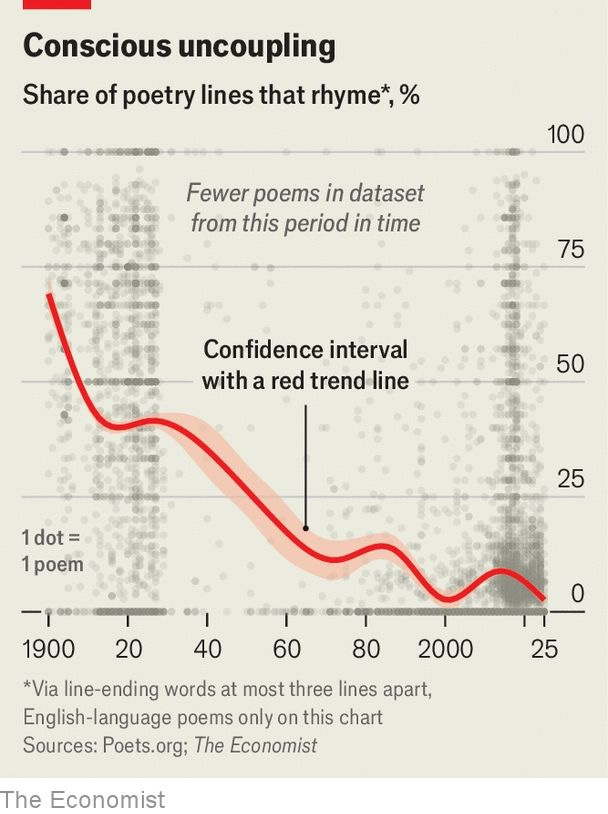
Another interesting graph from the Economist: the decline of rhyme in poetry. Obviously the trajectory is completely as you’d expect. An idle that occurs to me is … will make a comeback. One of the things AI seems to struggle with are traditional verse forms. Its rhymes are sometimes naff and clunking and its lines often don’t scan well. I wonder if that is because there is something especially human about metre and rhyme. They are part of the embodied experience of poetry. You have to say a poem out loud to feel its rhythm and its rhyme; perhaps that is something beyond the powers of a form of artificial intelligence based on verbal pattern recognition?
The AI poem is…
‘Thresh’ is machine-generated. ‘Leavings’ is Heaney. I think the clues to spot were the fact that ‘Thresh’ out-Heaneys Heaney: culverts, drowned fens, a spade etc. Plus there’s an over-saturation of compound words: flax-rope, hearth-deep, winter-starting, blue-grey, rain-slick, spindle-whorl. It would look a bit much to a human poet.
The human clues in ‘Leavings’ are probably fairly obvious. Why would an AI write a Seamus Heaney poem about Ely? Why would it mention Will Brangwen?
There’s also the fact the AI poem doesn’t really go anywhere or express an idea or allude to a specific bit of history. It just circles vaguely round its themes. AI still struggles a bit with story or argument — a lot of what it produces can feel somewhat inert. ‘Leavings’ has a bit of forward motion to it and contains a thought about the real world.
I put the two poems to an eminent literary critic who said it was further proof of what an unremarkable poet Heaney was. I’m a bit of a Heaney sceptic (please complain at me in the comments) and to some degree inclined to agree. Interestingly, AI is much worse at Philip Larkin. It seems to struggle slightly with variations of tone that are more complex than simply “poetic” (the register a lot of Heaney is written in). Its attempts to be wry or angry can fall flat. And Larkin often uses his poems to tell a story.
One final note: the AI Heaney poem was produced by a friend who fed it an actual Heaney poem and asked for the machine to produce its own version. This way of getting Chat-GPT to produce literature gets better results but arguably it’s as much plagiarism as it is real creativity as some of what it’s doing is just shuffling about the original piece of writing. If you ask it for a Heaney poem without any context, the result will probably be somewhat worse.
Finally, here is a Larkin poem about a Blackbird I got Chat-GPT to produce. In fairness to the AI I put it through a few drafts asking it to give a proper sense of Larkin’s use of obscenity and anger in his poetry (its first draft was much too sentimental and polite). But I think in the end it overdid it a bit.
To a Blackbird
You screeching piss-stain of a feathered smear,
perched there like a smug black blot on my day—
I ought to crack your beak off, grind your cheer
to squawking grit, just to shut you the hell away.
Every tuneless fart you fling across this yard
is one more jab in the rotten ribcage of dawn.
Christ, do you rehearse? Do you try this hard
to drill your shit hymn straight through my yawn?
Look at you—fluffed-up fleck of airborne bile,
eye like a dead battery, twitching for spite—
you peck at nothing, then gloat for a while
as if your pointless existence proved you right.
Fly off, you foul-mouthed scrap of carbon scum,
before I lose what’s left of my half-lit calm
and hammer your dumb little drum
into blessed, silent, wing-less balm.
You see what I mean about tone?
The biggest give away from LLMs (they are not 'AI', which might be developed some time in the future, because they have no semantics, they operate only on syntax), is that they say stupid things.
Since they are not embodied, they don't understand how the world works. The last two lines of the cod poem talk of the 'clink' of a standing spade - standing spades, we embodied creatures know, are silent.
Spotted the AI without even reading the second poem because it is just a list of things without connected ideas. Never read Heaney but this isn't a poem that "speaks to me" to use the horrible phrase.