
Hideous shouting by hideous people, airline bankruptcy madness, the spell of linguistic philosophy, Felicity Kendall's crimson talons
Plus more links and quotes

Hello!
Welcome to Cultural Capital. In The Times this week (cheerful as always) I wrote about how social media is re-introducing the idea of death as a form of entertainment:
Clearly casually scrolling through videos of murders is not remotely the same visceral and immediate experience as jeering and hooting a public hanging. But the return of killing as a mainstream entertainment marks the erosion of an important taboo. The 150 year period between the abolition of public execution and the arrival of social media marked a brief window in human history in which watching someone die was an abnormal and shameful recreation.
Astonishingly there are still tickets available to my event about the death of reading with Dominic Sandbrook.
Also I also hadn’t realised but my documentary about the history of reading is airing again on Radio 4. It goes out at ten past five on Sundays. You can listen to all the episodes on BBC Sounds here. Or on Spotify here:
Airline bankruptcy madness
David Oks (of elaborate Ghanaian funerals fame) is back with another banger. This piece explains one of strangest paradoxes of modern capitalism: airlines don’t make money.
Aviation is “an industry whose long-term equilibrium is losing money: an industry that, on a purely economic level, should not exist”, Oks writes. Overall “airlines as a sector destroy investor value”.
Warren Buffet called airlines a “bottomless pit” for investors and said someone should have tried to shoot the Wright brothers:
Airlines have a bad habit of going insolvent. This includes many of the most famous names in the history of aviation. Pan Am, long the unofficial flag carrier of the United States, ceased operations in 1991; Eastern Air Lines liquidated the same year […] Alitalia, Italy’s flag carrier, reported only a single year of profit since its founding in 1946 and was saved countless times by the Italian government before ultimately ceasing operations in 2021.
Even those airlines that survive for long periods of time are perpetually in financial distress. Between 1978 and 2005, more than 160 airlines filed for bankruptcy; virtually every major U.S. carrier other than Southwest has been to bankruptcy court at least once. In September 2005, every one of the four largest American airlines—United, Delta, Northwest, and US Airways—was operating simultaneously under Chapter 11 protection.
Oks says the answer is to do with game theory. The airline industry is set up in a way (very complicated - you really have to read the piece) that makes it impossible for it to reach a profitable equilibrium in a competitive market place. Competing airlines will inevitably just keep destroying each other and there’s not much anyone can really do about it.
Hideous shouting by hideous people
I’ve been enjoying Joe Moran’s history of television in Britain Armchair Nation. He’s fun on the moral panic around television. I love reading about old-school TV refuseniks:
Lord Beveridge, the wartime architect of the welfare state, told the House of Lords in January 1957 that he and his wife had seen BBC television while convalescing for ten days on the south coast. It seemed mostly, he felt, to consist of ‘hideous shouting by hideous people … Our conclusion, from our week of strenuous watching in the Bournemouth Hotel, is that we have both decided that we would not have television, even if it were offered us as a gift.’
These people are my spiritual forebears.
The spell of linguistic philosophy
That said … it is completely hilarious to watch some of the ludicrously highbrow television that was being broadcast around the time that people were complaining TV was destroying civilisation.
Last week I was complaining to a friend about how reading the Wittgenstein book (see last edition of Cultural Capital) a lot of the actual philosophy was going over my head. My brain just starts shutting itself down whenever Wittgenstein launches himself off into discussions about about how all logical propositions are necessarily tautologies or whether we can all agree if there is a beetle inside the matchbox or not.
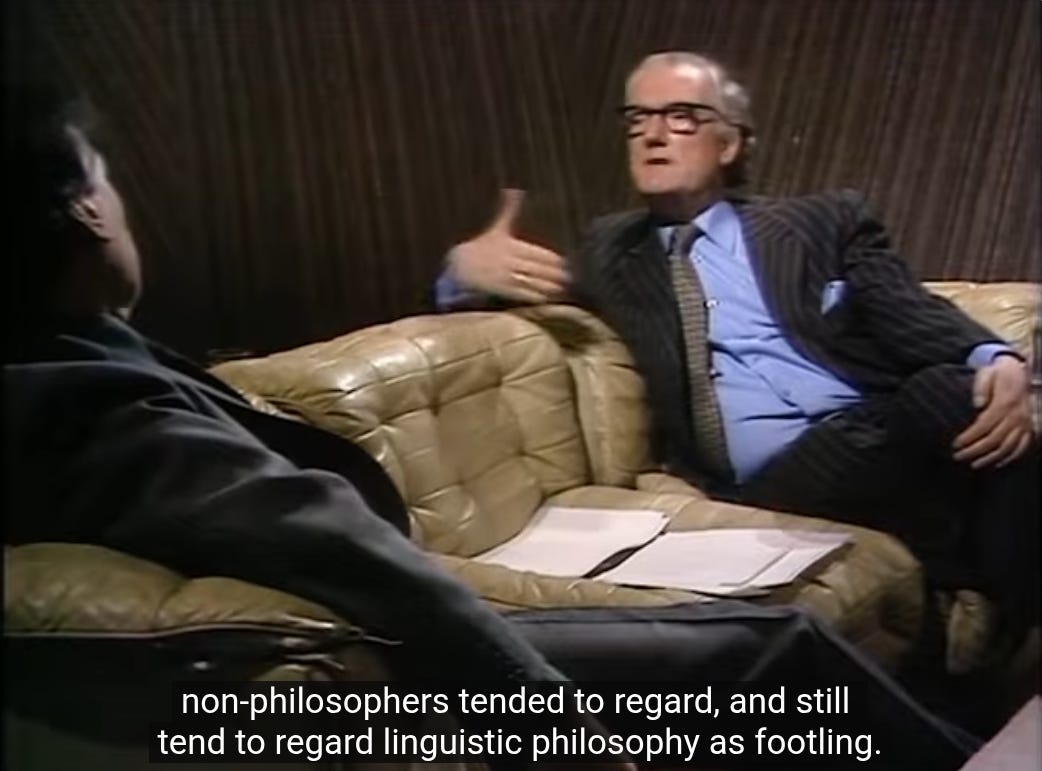
My friend directed me to this amazing episode of Bryan Magee’s famous philosophy TV Show Men of Ideas called the ‘The Spell of Linguistic Philosophy’. It consists of an hour long conversation about linguistic philosophy and was broadcast to the entire nation on BBC2 in 1977. Absolutely mad. WTF has happened to television in the last fifty years.
I also love how little concession the programme makes to the idea that television is supposed to be a visual medium. For some reason Bryan Magee and Bernard Williams are having their conversation about linguistic philosophy on what is probably the world’s least telegenic sofa.
Perhaps the idea is that the awfulness of the sofa will make you concentrate more on linguistic philosophy.
Author explosion
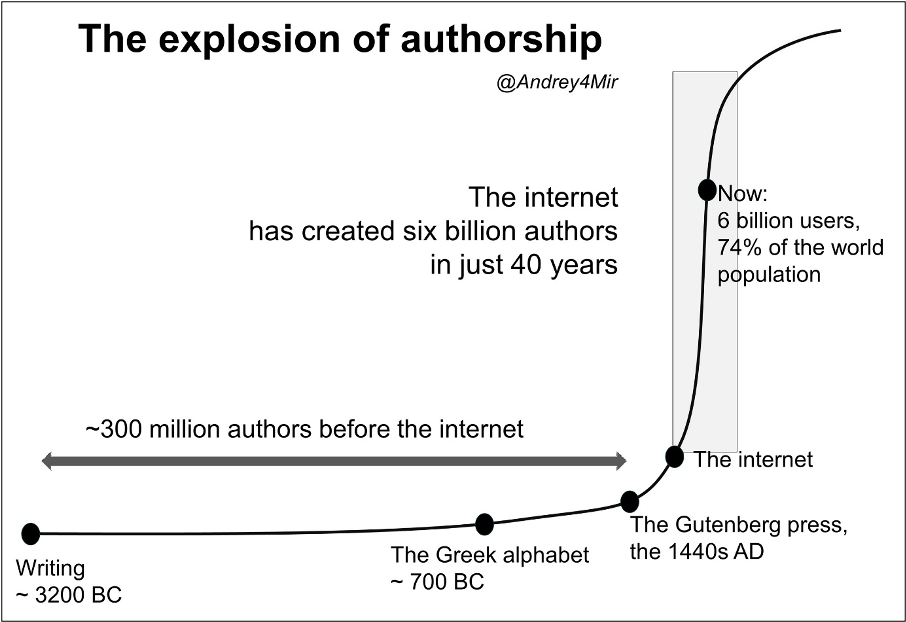
A very interesing piece by Andrey Mir touches on what he calls the emancipation of authorship. For most of history very few people were authors. And so very few people were ever able to have their ideas far beyond their immediate community. Mir calculates that “the estimated number of authors over five thousand years of human history, from the invention of writing to the internet, hardly exceeded 300 million”.
The internet of course changed everything. Now we can all publish our thoughts online there has been an exponential explosion of ‘authors’:
Over five thousand years, humankind accumulated about 300 million authors. Now, in a mere 40 years of the internet, the number has doubled if we count only heavy authors, or increased by orders of magnitude if we include all those who are digitally connected. We live in the midst of an unprecedented explosion of authorship that may explain many of the disturbances we have experienced over the past couple of decades.
Demon barber
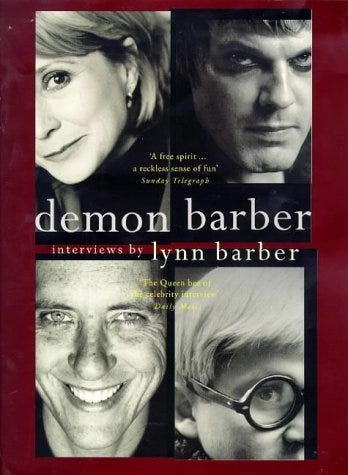
I mentioned last week that I had gone down a bit of rabbit hole reading interviews by the great British journalist Lynn Barber. The collection of her journalism, Demon Barber which I bought on Abe Books arrived last week. I loved it. She’s so sharp on people and has the brilliant habit of just saying what she thinks. In the middle of her interview with Felicity Kendall she blurts out:
Of course, she looked wonderful, wonderful skin, hair figure — even her neck is unlined — though I was secretly gratified to notice her hands looked older than mine, hideous, knotted bony claws with crimson talons.
It makes you realise that even good newspaper interviewers are concealing a lot of their impressions of their subjects — or perhaps have not really made an effort to be consciously aware of what they really think of their subjects.
I guess it’s part of Barber’s genius that she a) noticed her passing thought about Felicity Kendall’s crimson talons and b) recognised it was something worth mentioning to readers. It’s not only a sharp detail but contains all kinds of information about the currents of competition and hostility in the interaction (of a kind many interviewers would vainly prefer to pretend didn’t exist).
The book is also a marvellous portrait of Britain in the late nineties: Sarah Ferguson’s father, a young Graham Norton, a young-ish David Hockney, Dale Winton, Damien Hirst, Jarvis Cocker, William Rees Mogg. It’s a world which shaped me but one I was not really consciously aware of.
AI in Schools
A depressing piece in the New Yorker on AI in schools. LLMs are being widely deployed in education despite evidence that AI “may inadvertently contribute to cognitive atrophy” :
Then, in March, students at my eleven-year-old daughter’s public middle school began receiving new Google Chromebooks, and that is when I heard the tap-tap of the cloven hooves approaching our doorstep. The Chromebooks, which the students use in every class and for homework, came pre-installed with an all-ages version of Gemini, a suite of A.I. tools. When my daughter, who is in sixth grade, begins writing an essay, she gets a prompt: “Help me write.” If she is starting work on a slide-show presentation, the prompt is “Help me visualize.” She shoos away these interruptions, but they persist: “Help me edit.” “Beautify this slide.” The image generator is there, if she’d ever wish to pull the plug on her imagination. The Gemini chatbot is there, if she ever wants to talk to no one.
Things like this make me sympathetic to the anti-AI diehards who argue that we should never so much as touch it with a barge pole.
Shakespearean New Labour
For those in need of a podcast to listen to I loved this. On Talking Politics Helen Thomson and David Runciman wonder what the story of New Labour would look like as a Shakespearean tragedy:
Schizophrenia and blindness
This is fascinating: “not a single congenitally blind person with schizophrenia has ever been reported”:
Vision plays a powerful role in shaping this system, particularly in early life. The visual cortex is one of the brain’s largest and most richly connected regions, involved not just in sight but in learning, attention and emotion. When it receives no input from birth, the brain develops differently. Brain imaging studies show that in people with congenital cortical blindness, this area is often repurposed for tasks such as language, memory and reasoning.
Some researchers believe this early reorganisation may offer a kind of protection. Without visual input generating a constant stream of ambiguous or unpredictable signals, the brain may settle into more stable ways of interpreting the world, reducing the risk of the misfiring predictions that characterise schizophrenia.
Until next week!
James
Absolutely mad in the best way. There was a period when British television assumed we would willingly spend an evening with philosophers, cathedrals, paintings. Have you watched Civilisation? Kenneth Clark now makes Simon Schama look like Graham Norton.
I've had rather a boring day and was feeling sluggish. Thank you James for rebooting my brain and providing inspiration (and ideas) for a weekend of reading and thinking.