
The Moral Animal
Plus Meghan Markle, Augustus John and seriousness

Hello,
Welcome to Cultural Capital. This week in The Times I wrote about the very American weirdness of Donald Trump, touching on Bruno Macaes’s interesting theory that the United States is evolving away from Europe to become essentially a separate civilisation.
To my great delight the framed portrait of Robert Hughes I ordered from The New York Review of Books website has arrived:

I wrote about why I think we should fill our houses with portrait of our heroes in my Times notebook here. Incidentally the NYRB shop is great — they have prints of everyone, from Milton to Edward Said. I realise with regret that I could have ordered a Geoffrey Hill print. But one is probably enough.
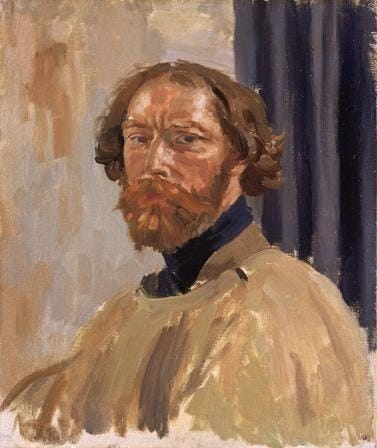
I’m currently working my way through two enormous biographies: Hermione Lee on Virginia Woolf and Michael Holroyd on Augustus John. Both are masterpieces and both highly enjoyable. It’s a shame that the Holroyd-type popular biography — 700 pages on a second tier cultural figure with a fascinating and illuminating life story — is basically extinct as a genre. The real geniuses are often more boring to read about (they are generally locked away working all the time) than the people a rank or two beneath them. Anyway will report back properly on these books later.
I also read (much more quickly) The Moral Animal by Robert Wright, which is a classic popularising work of evolutionary psychology.
Evolutionary psychology often gets a bad press. To its detractors it is a series of just so stories (women prefer soft lamplight because they evolved to sit in gloomy caves while men were out hunting etc) based on chronically irreplicable social science experiments that provide conservative conclusions about society: men and women are fundamentally different, social hierarchy is an inevitable feature of human society and so on.
I agree that evolutionary psychologists overdo it sometimes but fundamentally if you believe in evolution I think you have to accept that it has had an important role in shaping the brain. My two favourite books about evolutionary psychology are Good Reasons for Bad Feelings by Randolph Nesse which covers the evolutionary origins of mental ill-health — Nesse suggests that depression and anxiety aren’t aberrations but adaptive traits (anxiety is an important motivator, depression helps us force us to get out of evolutionarily sub-optimal situations like being single etc). And Beyond Bad by Chris Paley which is an excellent guide to the evolutionary origins of morality. I recommend both very highly. The Moral Animal is a good overall primer on the subject. It was interestingly reviewed by Steven Pinker here.
Other Things
Christians in America
New research finds that the decline of Christianity in America seems to have levelled off:
After many years of steady decline, the share of Americans who identify as Christians shows signs of leveling off – at least temporarily – at slightly above six-in-ten, according to a massive new Pew Research Center survey of 36,908 U.S. adults.
I would be fascinated to know what’s driving this. Are Trump-era Western civilisation conservatives becoming more likely to identify as Christian for cultural reasons?
Puffed Wheat
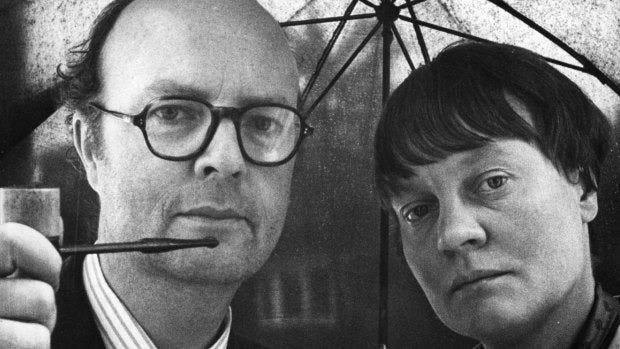
John Bayley’s book The Power of Delight was the first collection of literary criticism I ever bought. At that time of my life I was a highly un-discerning reader. I certainly had no consciousnesses that Bayley’s style of criticism — which his enemies would characterise as belletristic book chat — could be something to have a debate about. Last week I read James Wood’s superb review of The Power of Delight in the LRB. It is a stunningly intelligent and thoughtful piece of literary criticism. As well as a review of the book it is an interesting argument about what art should do and whether we should take it ‘seriously’:
In his journalism there is an old-fashioned Oxonian embarrassment about displaying seriousness (seriousness, of course, in the ‘good’ Bayley sense); he too often acts as if by hiding his actual beliefs they will somehow disappear and cease to be such a nuisance. [. . .]
Bayley’s apparently effortless cosiness may seem like a pose, but it is also an escape, an escape from his own actual seriousness about art, a seriousness which is almost religious. Bayley likes to quote Lawrence on how the novel is ‘incapable of the absolute’, something he himself clearly agrees with. Yet religiousness is an absolutism of a kind, and surely one should not be absolute about the non-absolute? This is exactly Lawrence’s contradiction, too, in a more vehement vein, in his fiction and criticism: being dogmatic about the importance of being undogmatic. Bayley’s solution, you might say, is to escape by being non-absolute about the non-absolute, by not insisting and bullying, as Lawrence does, but by playing a very English, very Oxford, role: the delightful, sometimes even dotty, common reader.
P.S. Frank Kermode reviewed the same book interestingly in the NYRB.
More Polygamy
I wrote about polygamy in my Times notebook this week. Ed West also tackled the subject (alas, much more interestingly than I did):
Morocco’s ruler Ismail Ibn Sharif had around a thousand children, and was likewise noted for his great cruelty and ruthlessness, apparently having the walls of the city of Meknes plastered with the heads of 10,000 enemy soldiers. In fact his total child count seems so high that a group of biologists even looked into the claims and found that ‘it would have been possible for Moulay Ismael to have 1171 children’ if he had sex three times every two days on average. Just imagine how grumpy he’d have been otherwise.
Pharaoh Ramesses II is said to have had over 100 children; Ibrahim Njoya, who ruled over the Bamum people in Cameroon, had around 350 from over 1,000 wives (a true Renaissance man, he also developed a writing system). King Sobhuza II of Swaziland produced 210 children during his record-breaking 82-year reign.
Why Britain Isn’t Working
Will Dunn offers a valuable corrective to the common idea that Britain is a nation of lazy scroungers using mental illness as an excuse to get out of working. Plus he has some good stuff on the unemployment policies of less enlightened governments:
Under the Tudors, unemployment was punishable by death. The looting of South American gold and silver by Spain had brought piles of newly created money back to Europe, causing inflation and falling real wages. In England, many people who would previously have stayed in their village began roaming for work. New laws were written to confront the issue of the “sturdy beggar”, an able-bodied person without a job. Under the Vagrancy Act of 1547, someone who had been out of work for as little as three days could be branded with a hot iron or enslaved. Repeat offenders were executed. In 1601 the first Poor Law was passed, and the state began to distinguish between the “impotent poor” – those unable to work – and the unemployed, for whom it decreed work would be found in a “house of correction” (prison, but with unpaid labour). Over time the punishments became less lethal but a principle had been established: some people were deserving of help, others were to be pressed into work.
Meghan Markle
Last weekend, I watched the first two episodes of With Love, Meghan. There is something tragic as well as insufferable about Meghan. It strikes me that she is (like many people in show business) desperate for attention and praise but not intelligent enough to work out how to get it. She is unable to judge social cues and trends well enough to come over as cool or likeable. Instead the series made her seem annoying and out of date I loved Rachel Cooke’s review:
Early on, Kaling makes the mistake of referring to a personage known as Meghan Markle. “No, I’m Sussex now!” instructs Meghan, struggling perhaps not to add that she’s also a Duchess. “Well, now I know,” says Kaling, her smile vaguely reminiscent of the glaze on one of Meghan’s cakes. Meghan pours them both some bubbles, and then they set about making crostini that look like ladybirds. Does Kaling know that in Britain, the home of Meghan’s husband, “ladybugs are called ladybirds”? Kaling sips her drink. “Yes, I’ve always found that confusing,” she says, dryly.
At this point, Meghan produces her fruit rainbow. “You’re kidding me!” shouts Kaling, her hand tight around the neck of the bottle of fizz. “It’s just fruit,” says Meghan, reassuringly. The episode ends – showtime! – with the pair of them sitting in some kind of greenhouse, eating the art house crostini. All Meghan needs to complete the full Marie Antoinette effect is a cow and a milking stool.
Poem of the Week: Pad Pad by Stevie Smith
I sometimes think that one of the most interesting challenges that poets face is how to get away with being serious. To dive straight into philosophical musing or hysterical emoting can seem adolescent and phoney. To be convincing and to succeed in really moving the reader, poems have to earn their moments of strong emotion. One instance might be Wordsworth musing conversationally on his memories of the hedgerows and woodland of the Wye Valley in Tintern Abbey before the poem works up to its transcendental lift-off. Because the emotion has been contextualised it is more believable — the poet has taken us with him rather than plunging us in at the deep end. And the contrast with the comparatively unexalted opening helps us to feel the heights the poet has attained, like the slight jolt you get a couple of minutes into a flight when you look out of an aeroplane window and see how high above the fields you suddenly are.
A particular master of the art is Philip Larkin, whose poems can launch themselves from grouchy swearing to sublimity in a space of a couple of stanzas — like (to use another aeronautical metaphor) one of those fighter jets that can get airborne using only the short runway of an aircraft carrier. The famous instance (which I’ve mentioned here before) is High Windows which gets from one of Larkin’s nastiest and most cynical openings (“When I see a couple of kids / And guess he’s fucking her and she’s / Taking pills or wearing a diaphragm”) to one of his most transcendent images (“The sun-comprehending glass, / And beyond it, the deep blue air, that shows / Nothing, and is nowhere, and is endless”) with exceptional dexterity.
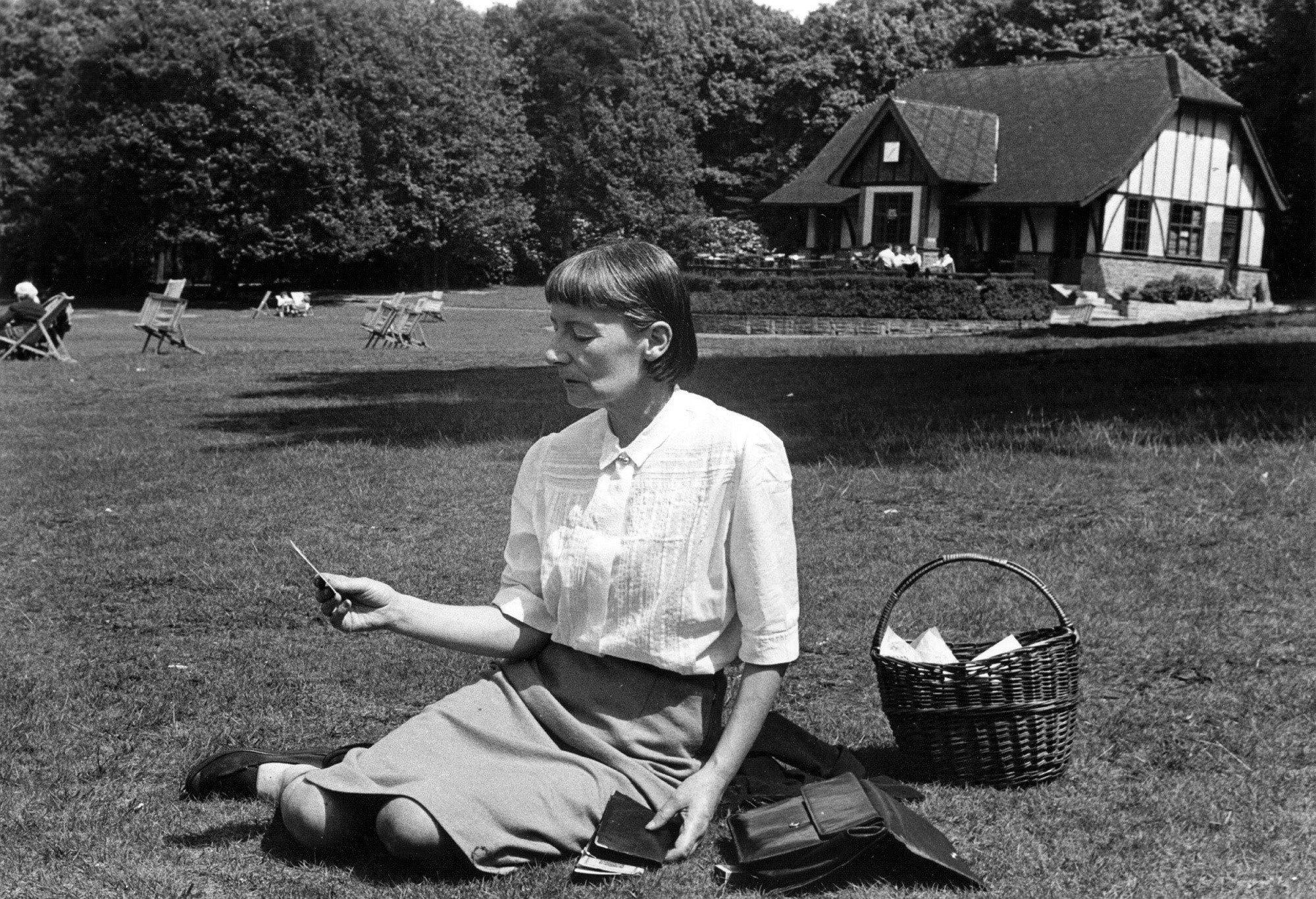
Stevie Smith often earns her emotion by couching her poems in a whimsical and wilfully eccentric nursery-rhyme language. In her books, her poems are accompanied by deliberately naive, child-ish illustrations. A good example is ‘Pad Pad’, which begins like this:
I always remember your beautiful flowers
And the beautiful kimono you wore
When you sat on the couch
With that tigerish crouch
And told me you loved me no more
The poem’s meter has a nursery rhyme swing to it. The kimono is a detail so arbitrary as to be whimsical — though perhaps with the “beautiful flowers”, the “couch” and the “tiger” it acquires a certain flavour of japonaiserie. Tigers often feature in children’s stories (though, of course, a tiger will always introduce a note of threat into a poem). Amidst this generally cheerful and unserious atmosphere, the line “And told me you loved me no more” arrives with a quietly devastating effect.
The poem acquires much of its power from the way the atmosphere of the children’s story works against the adult feeling of romantic devastation. I suppose the point might be that however grown-up we are, we remain, in some senses, merely overgrown children. And perhaps we feel our childish helplessness most powerfully precisely when we are being broken up with or otherwise emotionally wounded. The last lines of the poem are especially effective as they attempt pathetically to cling to an atmosphere of whimsy, even in the face of a very adult emotional exhaustion:
Ah me, the power to feel exaggerated, angry and sad
The years have taken from me. Softly I go now, pad pad.
I love the eclectic range of your reading, James, and that you share it so conversationally here and in The Times. I’m assuming you are a “fast reader” but nonetheless am curious to know: on average how many hours a day do you devote to reading? With so many options, how do you decide which books to prioritise?
Love Stevie Smith and went back to the whole poem. And I thought, is she reflecting on the way that the mellowing of maturity is somehow infantilising? That the tigers and emotional intensity of youth evolve into the childish banality of the repetition of ‘beautiful’ and the ‘pad pad’ of a pussycat? The poems’s only images of any power are the kimono and the tigerish crouch - exotic things of the past.